
Fert Calculator
Fertilizer labels give three numbers, but not how much to put down. This calculator turns the N-P-K analysis into pounds or grams of product for your lawn or bed, shows what you’re really applying, and — for planted-aquarium keepers — converts grams of dry salts into parts per million for your tank volume. Everything is calculated in your browser.
- Free to use
- No sign-up
- Runs in your browser
Fertilizer calculator
Lawn and garden
Planted aquarium dosing (dry salts)
Fertilizer Planning Template Pack
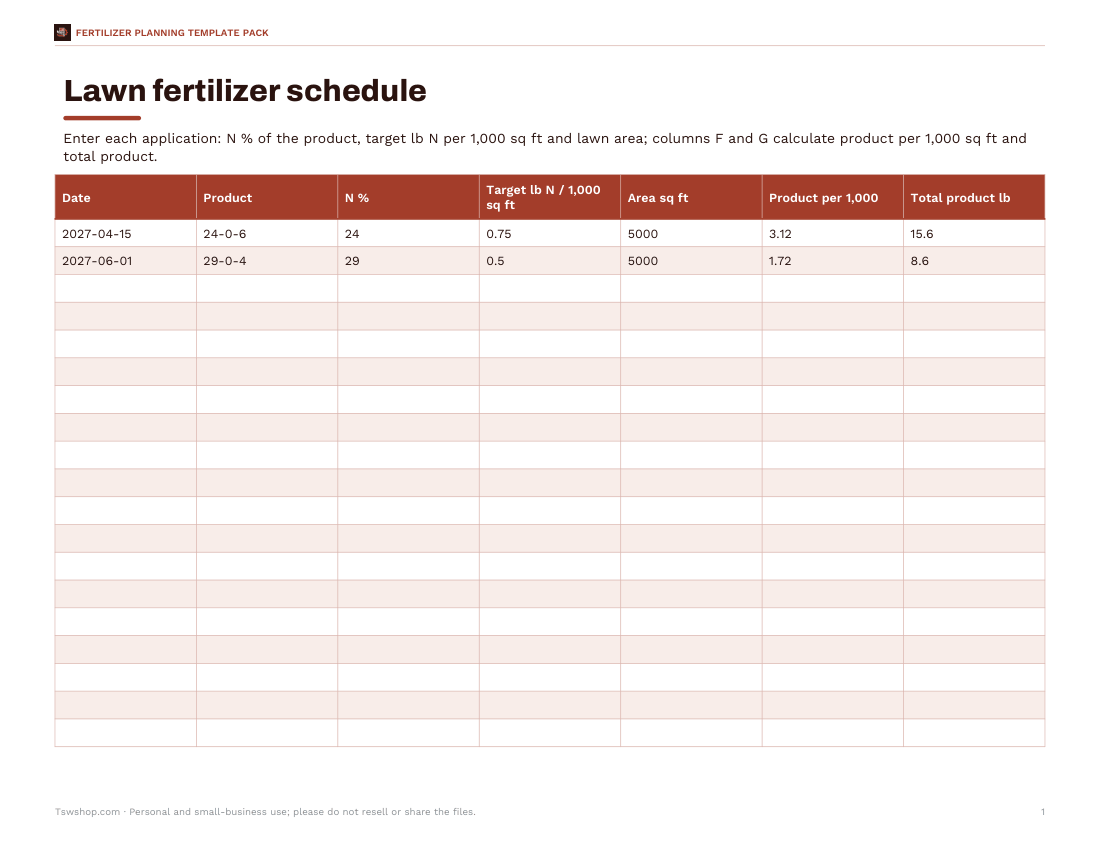
Lawn fertilizer schedule spreadsheet, soil test record, fertilizer application log, spreader calibration worksheet and an aquarium dosing log with ppm formulas.
- Lawn schedule (XLSX)
- Soil test record (PDF/DOCX/XLSX)
- Application log (PDF/DOCX/XLSX)
- Calibration worksheet (PDF/DOCX)
- Aquarium dosing (XLSX)
Formats: XLSX, PDF, DOCX. Instant download after payment (link valid 72 hours, up to 5 downloads). AI-assisted: the templates were drafted with AI help and reviewed and laid out before publishing.
$5.00 USD, one-time 5 files · about $1.00 each
- Instant download
- 7-day refund
- Secure checkout by Stripe
7-day money-back guarantee. Full refund within 7 days of purchase, even after you download.
Free sample: Lawn Fertilizer Schedule (PDF, 52 KB)
Full refund within 7 days — see the refund policy and license.
Free printables
Single sheets you can print right now, no sign-up. The full pack adds every sheet in one download plus the editable files.
 Printable Lawn Fertilizer Schedule
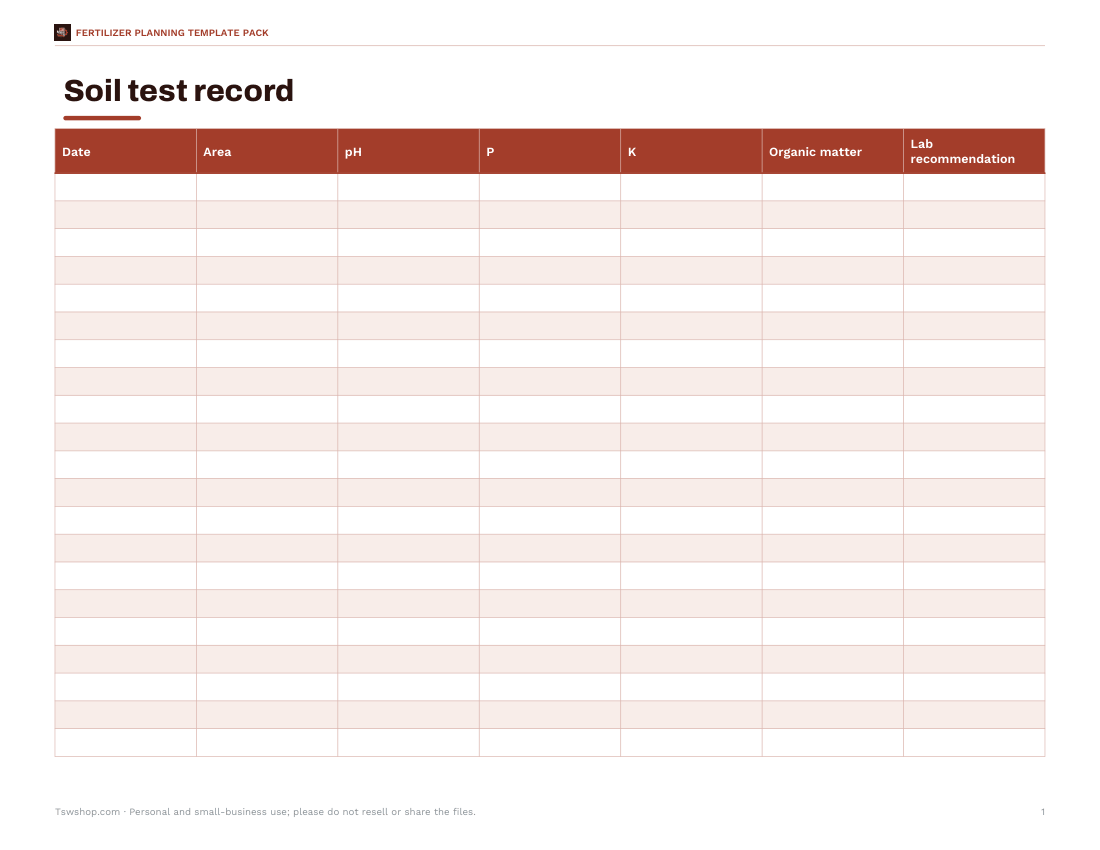
 Printable Soil Test Record Sheet
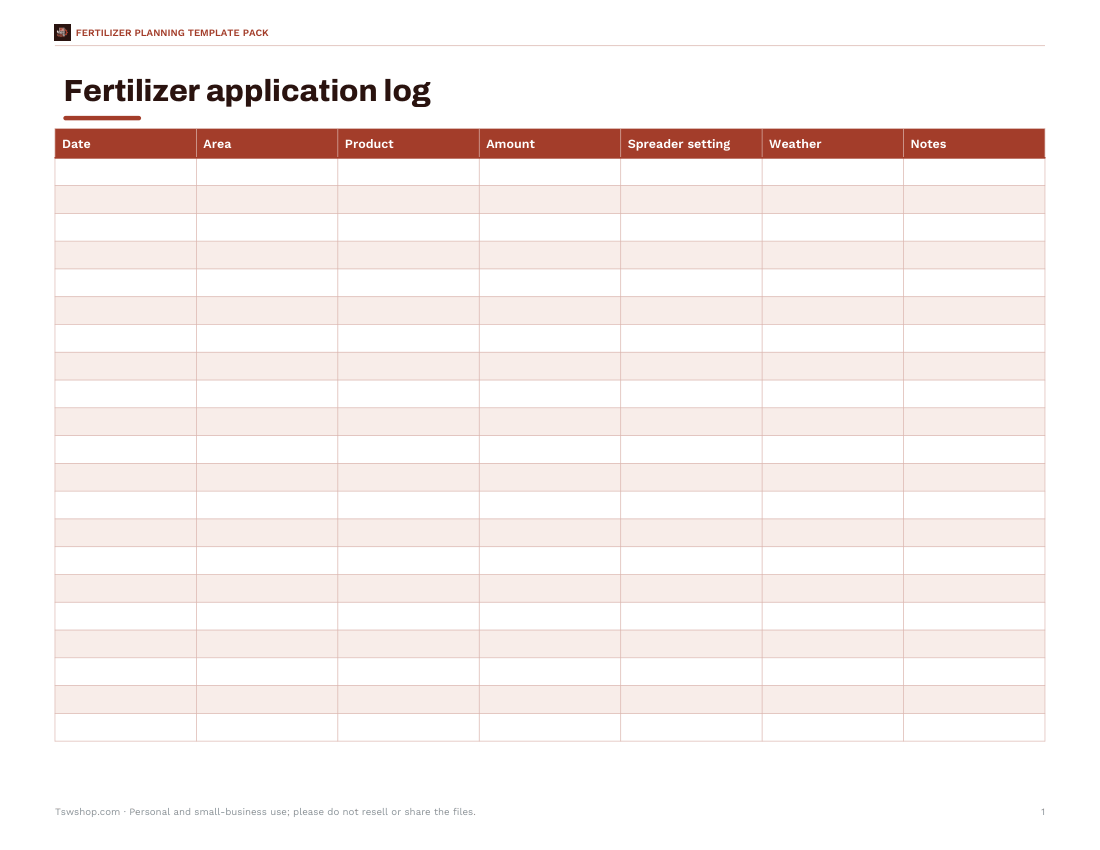
 Printable Fertilizer Application Log
 Printable Spreader Calibration Worksheet
 Printable Aquarium Dosing Log
Reading N-P-K numbers
The three numbers on a fertilizer bag are the percentage by weight of nitrogen (N), phosphate (P₂O₅) and potash (K₂O). A 15 lb bag of 24-0-6 contains 15 × 0.24 = 3.6 lb of nitrogen, no phosphate and 0.9 lb of potash. For historical reasons phosphorus and potassium are labelled as oxides: multiply P₂O₅ by 0.436 to get elemental phosphorus and K₂O by 0.830 to get elemental potassium.
The lawn formula
| Step | Formula | Example: 24-0-6, 1 lb N per 1,000 sq ft, 5,000 sq ft |
|---|---|---|
| Product per 1,000 sq ft | target lb N ÷ (N% ÷ 100) | 1 ÷ 0.24 = 4.17 lb |
| Product for the area | per 1,000 sq ft × area ÷ 1,000 | 4.17 × 5 = 20.83 lb |
| Bags needed | product ÷ bag weight | 20.83 ÷ 15 = 1.39 bags |
| Cost per lb of N | bag price ÷ (bag weight × N%) | $39.99 ÷ 3.6 = $11.11 |
Many lawn programmes apply around 0.5–1 lb of nitrogen per 1,000 sq ft per application, depending on grass type, season, soil and whether the nitrogen is quick- or slow-release. Your local extension service or the product label is the best guide for your lawn.
Worked example
A homeowner has a 5,000 sq ft lawn and a 15 lb bag of 24-0-6 costing $39.99. Aiming for 1 lb of nitrogen per 1,000 sq ft, they need 4.17 lb of product per 1,000 sq ft and 20.8 lb in total — 1.39 bags, so they buy two bags and keep the rest for later. One bag covers about 3600 sq ft. Nitrogen costs $11.11 per pound, which they compare with a cheaper 29-0-4 product.
Planted aquarium dosing
| Salt | Nutrient fractions by weight |
|---|---|
| Potassium nitrate (KNO3) | NO3 61.3%, N 13.9%, K 38.7% |
| Monopotassium phosphate (KH2PO4) | PO4 69.8%, P 22.8%, K 28.7% |
| Potassium sulfate (K2SO4) | K 44.9%, SO4 55.1% |
| Magnesium sulfate heptahydrate (MgSO4·7H2O) | Mg 9.9%, SO4 39.0% |
| Potassium chloride (KCl) | K 52.4%, Cl 47.6% |
| Urea (CO(NH2)2) | N 46.7% |
Aquarium keepers who dose dry fertilizers measure nutrients in parts per million (mg per litre). ppm added = grams × fraction × 1,000 ÷ litres. For example, 1 g of potassium nitrate in a 120-litre tank adds about 5.1 ppm of nitrate and 3.2 ppm of potassium. Fractions are calculated from each salt’s molecular formula.
Using fertilizer responsibly
- Sweep granules off paths and driveways back onto the lawn — they wash into drains and streams.
- Don’t fertilize before heavy rain or onto frozen ground.
- Many areas restrict phosphorus on lawns unless a soil test shows a need.
- Test soil every few years to see what your lawn or garden actually needs.
- Store fertilizer dry and away from children and pets.
Quick-release vs slow-release nitrogen
| Type | Examples on labels | Behaviour |
|---|---|---|
| Quick-release (water-soluble) | Urea, ammonium sulfate | Fast green-up; higher risk of burn and leaching; smaller, more frequent doses |
| Slow-release | Polymer- or sulfur-coated urea, methylene urea | Feeds over weeks; steadier growth |
| Organic | Composted manure, feather meal | Released as soil microbes break it down; lower N percentages |
Labels often state what share of the nitrogen is slow-release. Products with more slow-release nitrogen can usually be applied at higher single rates, within the label’s limits.
Metric conversions
- 1 lb per 1,000 sq ft ≈ 4.9 g per m² (≈ 49 kg per hectare).
- 1 g per m² = 10 kg per hectare.
- 1 kg per 100 m² = 10 g per m².
- Switch the calculator to metric to enter grams per square metre directly.
Spreader calibration
Spreader settings on bags are a starting point. To check yours, spread over a measured area — say 100 sq ft on a tarp or driveway — collect and weigh what was applied, and compare with the rate the calculator gives. Adjust the setting and repeat until they match. Walking at a steady pace and overlapping passes as the spreader manual advises gives even coverage.
What’s in the template pack
- Lawn fertilizer schedule spreadsheet that calculates product per application
- Soil test record sheet
- Fertilizer application log
- Spreader calibration worksheet
- Aquarium dosing log with ppm calculations
The pack is a one-time download; the calculator is free.
Frequently asked questions
What do the numbers on fertilizer mean?
Percent by weight of nitrogen, phosphate (P₂O₅) and potash (K₂O).
How much fertilizer per 1,000 sq ft?
Divide your nitrogen target by the N percentage: for 1 lb N with 24-0-6, about 4.2 lb of product.
How do I convert P₂O₅ to P?
Multiply by 0.436.
How do I convert K₂O to K?
Multiply by 0.830.
How is aquarium ppm calculated?
Grams × nutrient fraction × 1,000 ÷ litres.
Is my data saved?
No. Everything runs in your browser.
What does 10-10-10 mean?
10% nitrogen, 10% phosphate (P₂O₅) and 10% potash (K₂O) by weight.
Can I use lawn fertilizer in the vegetable garden?
Check the label: some lawn products contain weed killers that must not be used on edible plants.
Why are aquarium doses given in ppm?
Because ppm (mg per litre) lets you compare doses between tanks of different sizes.
How often should I fertilize my lawn?
Many cool-season lawns are fed two to four times a year; follow local guidance for your grass type.